
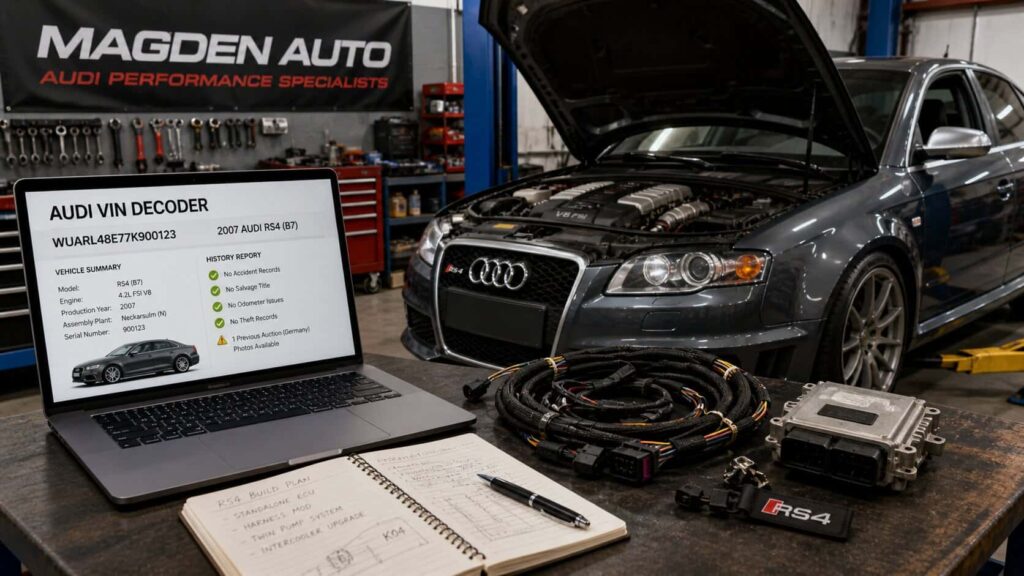
VIN Decoding an Audi Tuner Chassis Prior to Harness Installation
As we noted previously, Audi has reached the sweet spot where RS4s, S4s, and RS6s actually trade in the price range of those with a standalone-ECU build budget. A 2007 RS4, originally priced at nearly $66K USD, can be bought used at $30K-$40K and with 90K miles on the odometer; the 2014 S4 with the supercharged 3.0 TFSI engine will run $18K. That low point explains why hidden damage, odometer manipulation, or flagged VIN events bring down many builds; a tunner who has priced in an EMS, wideband oxygen sensor, flex-fuel conversion, and a transmission cooler does not want to find rust underneath the fender sealer skim or discover that the 4.2L V8 sitting in the trunk belongs to a different model year than the dashboard. Those history flags need to come up before the harness gets modified.
PRV and Body Inspection via VIN Report
Paint thickness readings (PRV) on the Audi RS4/5/6 line generally land within the 110-140 micron band from the factory; door skin readings generally fall higher than the rest of the body panels. Readings beyond 250 microns on one panel suggest filler and repair. An RS4 rear quarter with a reading above 400 microns has been found on cars with a perfectly clear Carfax, as the vehicle had been acquired from a Copart auction in Germany that was never recorded on an American title.
Audi VIN numbers carry a wealth of information for those who can decode them. Digit 10 gives the model year, 11 indicates the assembly plant (an N signifies a build done in Neckarsulm, home of the Audi factory building the RS series; most S series vehicles are built in Ingolstadt, indicated by an A), and digits 12-17 give the production serial number. An example of B7 RS4 VIN number beginning with WUARL48E would not normally be found on a chassis tag with the date stamp for 2008; this suggests that either the dashboard or the door cards have been swapped since manufacture. Running an Audi VIN check & history report prior to placing a bid grants the tuner access to ownership history, title change records, auction pictures, and any odometer manipulation flags or outstanding liens at one stop.
Service Book Tampering and the European Source Vehicles
Many of the RS4s and RS6s available in the United States originate through European sources – rejected by German fleet operators or total losses reported by Dutch insurance companies, but subsequently re-registered in America. Service books on such vehicles are often in order simply because the stamps on them are authentic. But the service book will say nothing about the accident at Karlsruhe that resulted in the removal of the front subframe. Or that the odometer reading of 88,000 kilometers has been rounded down to 54,700 miles. Or that the brake rotors were replaced four times and the steering column twice. Some things are only told through numbers.
A comprehensive VIN history report cross-checks accident data against the records of total-loss claims registered with European insurance companies as well as with American ones. Tuners who bypass that check risk having to rebuild an entire front clip simply because the previous owner chose to hide a bent radiator support. The aluminum front subframe used by the B7 RS4 is particularly difficult to fix in such cases – once deformed, there will always be flexing when mounting an intercooler bracket for a chassis mount cage.
Detecting K04 Swap and RS4 ECU Firmware Revisions
Sometimes S4s with K04 hybrids are listed as ‘RS4 swap’ to increase the price of sale by $8K-$15K USD. A real swap entails moving not only the 4.2L FSI V8 engine but also the DRC suspension hardware, the Recaro seats, and the RS4 dashboard cluster; doing so will require a significant re-work of the engine bay harness. As for the engine itself, VIN history will tell you whether it was an actual swap. A WAUDF78E S4 chassis will never be an RS4 regardless of the badge; for the engine bay harness, the ABS module, and the airbag controller, chassis data trumps all.
B7 RS4 owners are particularly prone to engine problems due to the complexity of the 4.2L V8 engine; in addition to needing new lifters regularly, there were actually three revisions of the cold start code that resulted in different lift-tick requirements. Thus, while an early revision vehicle is unlikely to run well after tuning, there is no way to know it until the car hits the dyno. The S4 supercharger assembly has a documented lifespan in the range of 90K to 110K miles; the BV30 rotor pack sheds coupler material. VIN history flagging a power train component claim made in 2019 is priceless information for the tuner – it means that the original rotor pack has been in use since day one, with a high probability that the turbo is nearing failure.
Tracking BV43 Replacements on the C7 RS6 Engine
C7 RS6 Avant and the twin-turbocharged 4.0 V8 engine suffer from an identical issue to the S4’s – they require a turbo replacement approximately 80-120K miles into their service life. As a result, there was a peak in Audi extended warranty claims against the turbos in 2018-2020. Flagging a VIN report to see if such a claim existed against the vehicle provides valuable insight – either the replacement happened during extended coverage and the new units are still under warranty, or the claim was denied and the old ones are still turning; either case requires additional maintenance line items. Not doing so leaves the tuner to deal with the replacement at high boost – with the rotor core selling for around $4K USD a piece and labor included, that is not an ideal situation.
The overall pattern remains the same for all four chassis models discussed. The advantage of the standalone-ECU setup is that it provides the necessary control over injection, ignition, and boost pressures. What cannot be controlled retrospectively is whether the chassis has been in tip-top shape prior to the purchase. While a pre-purchase inspection is essential at the same time, a thorough VIN check performed prior to bidding eliminates many potential problems that no test bench will ever reveal.