Understanding air-fuel ratio is fundamental to safe and powerful tuning. We break down why wideband O2 sensors are non-negotiable.
When you modify an engine to flow more air, you must supply the correct amount of fuel to match. The exact proportion of air to fuel entering your engine’s combustion chamber is known as the air-fuel ratio (AFR). For standard gasoline, the ideal stoichiometric mixture is 14.7 parts air to one part fuel. This ratio provides a complete burn for normal cruising and light throttle application.
However, high-performance engines rarely operate in standard conditions. When you apply heavy throttle, add a turbocharger, or spray nitrous, that 14.7:1 ratio goes out the window. You need a richer mixture to keep temperatures down and prevent catastrophic engine damage. Guessing the amount of fuel your engine needs is a fast track to broken pistons and bent rods. You need precise, real-time data to make accurate adjustments.
What is a Wideband O2 Sensor?
An oxygen (O2) sensor sits in your vehicle’s exhaust stream and measures the amount of unburned oxygen exiting the engine. This data tells you the exact mixture of air and fuel that was just burned in the combustion chamber.
A wideband O2 sensor is a specialized exhaust sensor capable of reading a vast range of air-fuel ratios. While older technology can only detect a narrow window, a wideband unit can read mixtures as rich as 10:1 and as lean as 20:1. This broad spectrum gives tuners a continuous, highly accurate digital picture of what is happening inside the engine at any given millisecond.
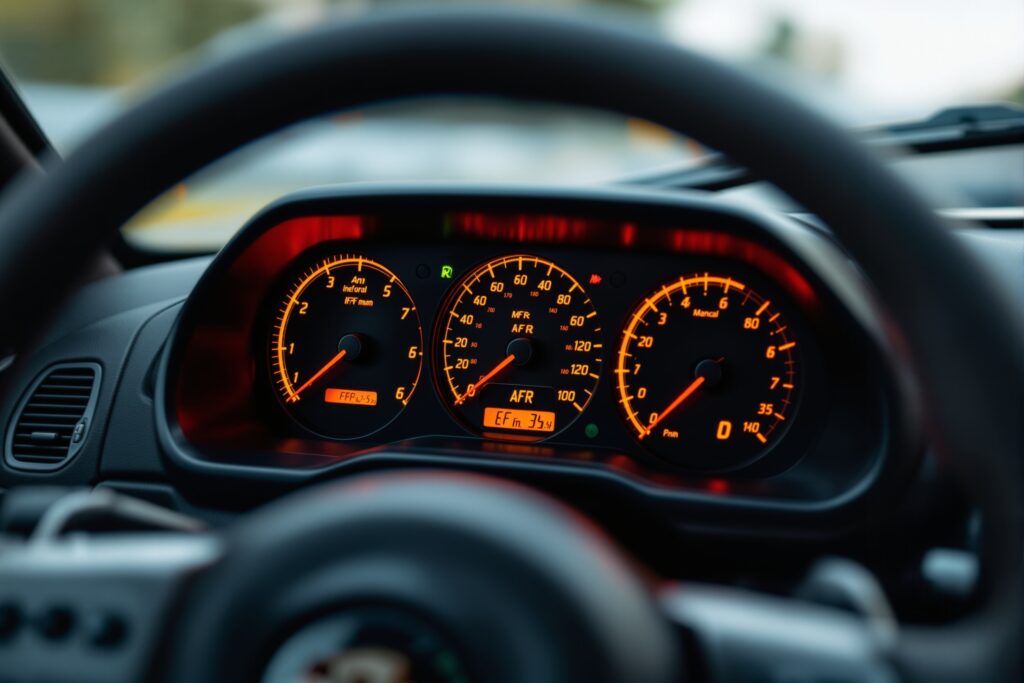
Modern wideband systems typically consist of the sensor itself, a control unit, and a gauge or direct output to the engine control unit (ECU). The controller processes the sensor’s complex signals and translates them into a readable AFR number.
Wideband vs. Narrowband: The Critical Differences
To truly appreciate the value of a wideband system, you have to understand the limitations of standard equipment. Most factory vehicles from the 1980s through the early 2000s came equipped with narrowband sensors.
The Limits of Narrowband
A narrowband sensor operates much like a simple on/off switch. It is calibrated strictly around the stoichiometric 14.7:1 ratio. If the mixture drops to 14.6:1, the sensor reports “rich.” If the mixture rises to 14.8:1, the sensor reports “lean.”
The narrowband sensor cannot tell you how rich or how lean the engine is running. When you accelerate hard in a modified car, your target AFR might be 11.5:1. A narrowband sensor will simply scream “rich!” at this level, providing absolutely no useful scaling. You will have no idea if your actual ratio is a safe 11.5:1 or a dangerously flooded 9.0:1.
The Precision of Wideband
A wideband sensor operates like a highly calibrated measuring tape. Instead of flipping between rich and lean, it uses a sophisticated pumping cell mechanism to measure the exact oxygen content in the exhaust gas.
If your engine is running at 12.3:1, the wideband tells you it is exactly 12.3:1. As engine RPM increases and your fuel injectors work harder, you can watch the mixture change incrementally. This continuous feedback loop allows you to map your fuel delivery precisely across the entire RPM range.
Why Wideband Sensors Are Non-Negotiable for Safe and Powerful Tuning
Bolting performance parts onto a car is only half the battle. The real magic happens in the tune. Without accurate AFR readings, tuning is basically blind guesswork.
Preventing Catastrophic Engine Failure
The greatest enemy of a high-performance engine is detonation, commonly known as engine knock. Detonation occurs when the air-fuel mixture ignites prematurely or unevenly inside the cylinder. This creates massive pressure spikes that can crack pistons and destroy bearings in a matter of seconds.
Running a lean mixture (too much air, not enough fuel) under heavy engine load drastically increases combustion temperatures, leading directly to detonation. A wideband sensor allows you to monitor the mixture under wide-open throttle. If the AFR starts creeping toward a lean condition, you can immediately let off the throttle and add fuel in the tuning software before any damage occurs.
Extracting Maximum Power
Engines make their best power at very specific air-fuel ratios. Naturally aspirated engines often perform best around 12.8:1 to 13.2:1 under heavy load. Forced induction engines, like those with turbos or superchargers, require richer mixtures around 11.0:1 to 12.0:1 to keep combustion temperatures safe while maximizing boost.
A wideband setup allows you to target these exact numbers. You can adjust your fuel maps cell by cell, ensuring the engine gets the perfect amount of fuel at every RPM. This precise calibration unlocks hidden horsepower that a generic base map leaves on the table.
Improving Drivability and Efficiency
Tuning is about more than just wide-open throttle pulls. A properly dialed-in vehicle should start easily, idle smoothly, and cruise efficiently on the highway.
Wideband sensors help you optimize the closed-loop cruising areas of your fuel map. By targeting exactly 14.7:1 during light throttle highway driving, you can maximize your fuel economy and prevent your spark plugs from fouling. The result is a high-horsepower build that still drives like a reliable daily commuter.
Elevating Your Tuning Strategy
The days of reading spark plugs to guess your engine’s fuel mixture are largely behind us. Modern tuning requires modern data. Whether you are dialing in a standalone ECU, adjusting a piggyback controller, or flashing a factory computer, precise AFR logging is the foundation of the entire process.
A wideband O2 sensor protects your heavy financial investment in engine parts while allowing you to extract every ounce of reliable power. If you plan on modifying your vehicle’s airflow or fuel system, make a wideband gauge your very first purchase. It will pay for itself the first time it helps you avoid a blown motor.